
Module 2 · Relationships 101
Module 2: Boundaries, Communication, and Showing Up for Each Other
Skill-Building Is Prevention
Module 1 laid out what healthy relationships look like. This module is about how to actually build and sustain them. These skills matter in our individual relationships and in our communities. When more people know how to communicate assertively, set and respect limits, navigate conflict without cruelty, and show up for each other well, it changes what's normal. It makes it harder for unhealthy dynamics to take root and easier for people to recognize and name them when they do. Skill-building is prevention. The earlier these skills are developed and practiced, the more protective they become for you, and for the people around you.
What Boundaries Actually Are
A boundary is a limit you set about what you will and won't accept in your relationships.
Here's an important distinction: a boundary is about your behavior and choices, it's not about controlling another person. You can't force someone to respect your limits. But you can be clear about them, and watch how they respond. A person who consistently ignores or pushes back on your limits is telling you something about their capacity, or willingness, to honor your boundaries.
Understanding Boundaries – Yours and Other People’s
Boundaries only work when people can communicate them, and that goes both ways. Here are four questions worth thinking through:
How do other people know what your boundaries are? Boundaries don't enforce themselves. Other people can't respect limits they don't know about. Part of building healthy relationships is finding ways to communicate your limits clearly, before they get crossed. This takes practice, and it's okay if it feels uncomfortable at first.
How do you learn what other people's limits are? The same applies in reverse. Asking someone directly "Is this okay with you?" or "How do you feel about that?" is a sign of respect, not weakness. It's healthy to talk about limits with the people in your life.
How do you recognize when you've crossed someone else's boundary? Sometimes it's obvious. Other times, you might notice it in how someone responds. They go quiet, pull back, or seem off. Paying attention to these signals, and being willing to ask "Did I say something that didn't land right?" is part of being a good partner, friend, or community member.
How do you respond when someone crosses one of yours? This is one of the hardest skills to build. It helps to pause before responding (more on that below), name what happened, and say what you need going forward. You don't have to manage the other person's reaction, you just have to be clear about your own experience.
Resentment as a Signal
One sign that a boundary has been crossed, sometimes before you've even consciously named it, is resentment. That low-level feeling of frustration, distance, or "I keep doing this and it keeps happening" is worth paying attention to. It often means something needs to be named or addressed. Resentment that builds without being addressed tends to damage relationships over time. Think of it as an early warning signal worth listening to, not pushing down.
How to Communicate a Limit
Expressing a boundary clearly is a skill and like most skills, it gets easier with practice. A simple way to communicate a boundary: "When [X happens], I feel [Y]. I need [Z]."
For example: "When you go through my phone without asking, I feel like you don't trust me. I need you to ask before doing that."
or
“When you refer to me by my old name when you introduce me to people, even when we've talked about this, I feel disrespected and unsafe. I need you to use my correct name, always, not just when it's comfortable for you.”
Some things that are always yours to decide:
Whether, when, and to whom you come out.
How you express your gender.
What happens with your body.
Who you spend time with and when.
Communication Styles
How we communicate our needs, feelings, and limits varies, and not all styles work equally well. Here are four common ones:
Aggressive - Direct and clear, but delivered in a way that overrides or dismisses the other person. Can feel like an attack. Gets your point across but often damages the relationship in the process. Example: "You never listen to me. You're being completely selfish."
Passive - Avoids conflict by not expressing needs or feelings directly. Keeps the peace in the short term, but needs go unmet and feelings build up over time. Example: "It's fine, don't worry about it." (When it is not fine.)
Passive-Aggressive - Indirect expression of frustration or needs. Appears fine on the surface but communicates displeasure through avoidance, sarcasm, or subtle digs. Often leaves the other person confused and the issue unresolved. Example: "Sure, I'll just do everything myself. Like always."
Assertive - Direct, honest, and respectful. Expresses your needs and feelings clearly without attacking or shutting down the other person. This is the goal. Example: "When plans change last minute, I feel stressed and unimportant. Can we talk about how to handle that differently?"
Assertive communication creates space for both people to be heard. It allows you to express your thoughts, feelings, needs, and boundaries clearly while also respecting the thoughts, feelings, needs, and boundaries of others.
Building this skill takes time, especially if you grew up in an environment where direct communication wasn't modeled or safe. Be patient with yourself.
LGBTQ+-Specific Communication Contexts
Some communication challenges come up more often, or feel higher-stakes, in LGBTQ+ relationships and communities. The assertive communication skills in this module apply directly to all of them.
Coming Out Conversations
Deciding if, when, and how to come out to a partner's family, in a new workplace, or to a friend, involves real risk and requires the ability to name your needs clearly. Assertive communication is how you express where you are, what you need, and what you're not ready for, without having to apologize for any of it. It also works in the other direction: if someone in your life is navigating their own coming out, checking in rather than assuming is assertive communication in the form of care. Try asking "How do you want me to handle your identity if someone asks?"
Navigating Visibility and Privacy
In a small, close-knit state like Wyoming, LGBTQ+ people often have to make real-time decisions about visibility, like how “out” to be in this store, at this family gathering, or in this town. Those decisions belong to you, and communicating your needs around them to a partner or friend is a healthy, reasonable thing to do. "I'm not comfortable being out in this context, and I need you to follow my lead." is a complete sentence. A partner or friend who respects you will honor it without making you justify it.
Respecting how people identify and express themselves
Using the name and pronouns someone goes by, paying attention to how they present themselves, and checking in rather than assuming are examples of respectful communication. In a healthy relationship, this happens consistently. When someone makes a mistake, the caring response is a quick correction and moving on, not a lengthy apology that centers their discomfort over yours. If you're the one making the mistake, the four-part apology framework from later in this module is a useful tool: take responsibility, acknowledge the impact, ask what the person needs, and name what you'll do differently.
Conflict in close-knit community spaces
In small LGBTQ+ communities, conflict can feel especially loaded because the same people show up everywhere: at community events, in friend groups, and in online spaces. That overlap can make it tempting to avoid direct communication and handle things through side conversations or mutual friends instead. But assertive communication matters most in exactly these situations. Naming what happened directly, expressing what you need, and working toward resolution without drawing the whole community into it protects not just the individuals involved, it protects the community itself. A community where people can have hard conversations with each other is a stronger one.
Respond, Don’t React: The Feeling-Pausing-Doing Framework
When something upsets us, our instinct is often to act immediately on that feeling. That response is called reacting and it doesn't always serve us well.
Responding is different. It means creating a little space between the feeling and the action.
Reacting moves directly from feeling to doing. The gap is short, and the action is driven by the emotion in the moment.
Responding takes the longer path. Feeling, then pausing, then doing. The pause is where you ask: What do I actually need here? What outcome do I want? What's the most useful thing I can do right now?
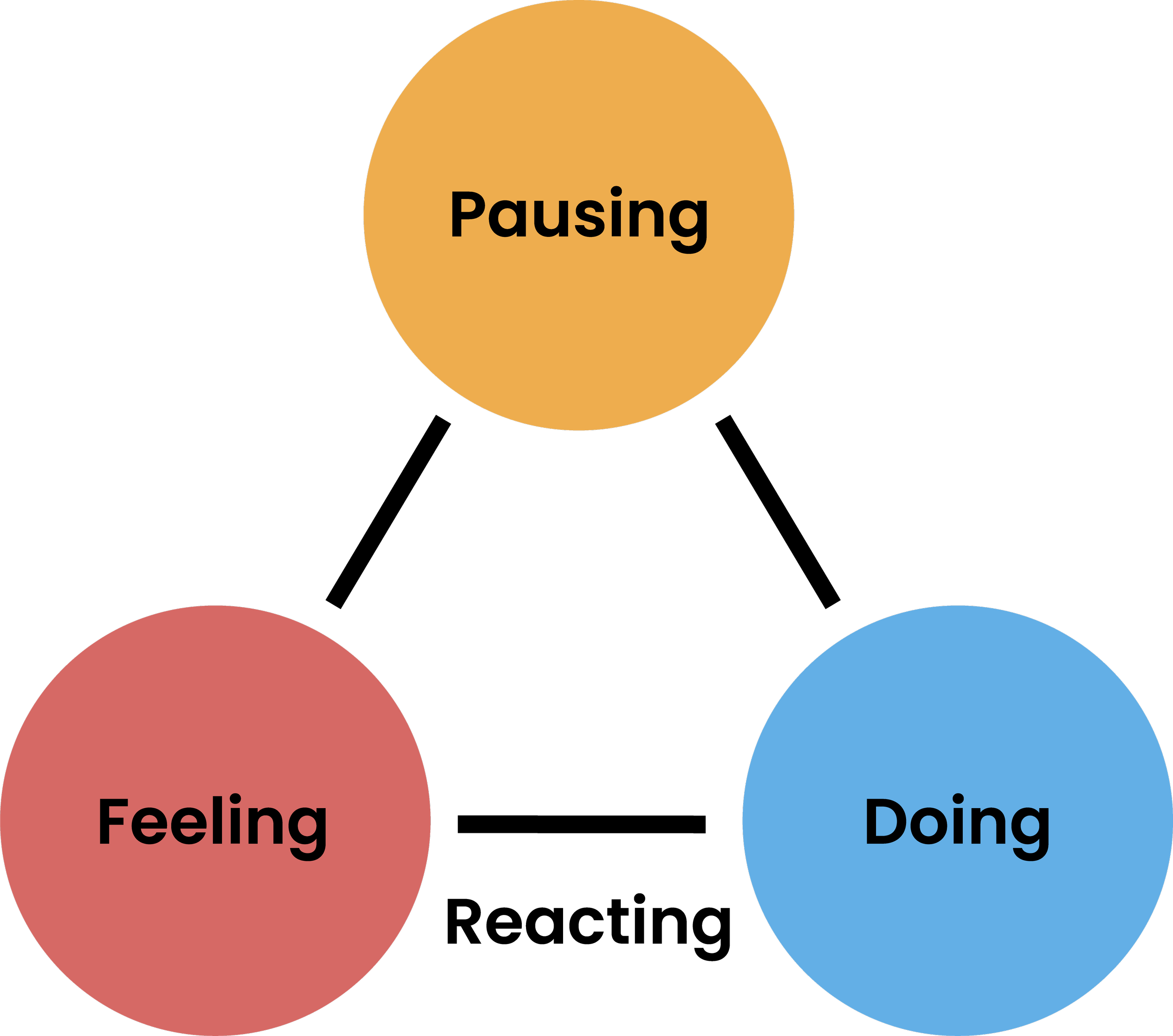
The pause doesn't have to be long. It can be a breath, a walk around the block, or simply counting to ten. What matters is that you choose to do so, and that means you are choosing your response rather than just having one.
This is especially useful in conflict. Strong emotions are normal and valid. Acting on them immediately, without pause, is where things tend to go sideways.
Conflict Happens – Even in Healthy Relationships
If you take everything in this module seriously and practice these skills consistently, conflict will still happen. You haven’t failed, this is just reality.
What changes with practice is not whether conflict happens, but how it's handled. Healthy conflict looks like:
Both people feeling safe enough to say what they actually think.
Disagreement that doesn't become contempt or cruelty.
A willingness to hear the other person's perspective, even when you disagree.
Working toward resolution rather than winning.
One disagreement, one hard conversation, or one moment of saying the wrong thing does not define a relationship. Patterns do. The goal is not a conflict-free relationship, it's a relationship where conflict is handled with care.
The Four-Part Apology
When you've hurt someone, intentionally or not, knowing how to apologize well is a real skill. A genuine apology has four parts:
Take responsibility. Name what you did. Be specific. Do not follow it with "but". A "but" cancels out the accountability. "I said something hurtful when I was frustrated, and that was wrong."
Empathize. Acknowledge the impact on the other person, not just your intentions. "I can see why that made you feel dismissed."
Make amends. Where possible, try to repair what was broken. This might be an action, a changed behavior, or simply asking "What do you need from me right now?"
Set an intention. Name what you will do differently going forward, specifically. "Next time I feel myself getting heated, I'm going to take a break before I respond."
One important note: this only works if it's sincere. An apology that hits all four steps but is delivered without genuine care is a script, not an apology. The goal of the 4-part apology is to actually repair the relationship, not just to move past the discomfort.
Showing Up for Someone Having a Hard Time
Part of being in community with people is knowing how to show up when something is wrong, even when you don't have all the answers.
If someone shares something difficult with you, these responses tend to help:
"I believe you."
"I'm glad you told me."
"What do you need right now?"
"I'm not going anywhere."
And these tend to hurt, even when they come from a good place:
"Why don't you just [fix it / leave / say something]?"
"Are you sure it's really that bad?"
"But they seem so nice."
You don't need to have solutions. Staying present and non-judgmental, without pushing someone toward a particular action, is often the most meaningful thing you can offer. Knowing how to listen well is one of the most underrated skills in any community.
Don't make promises you can't keep. Be honest about your limits and communicate them clearly. Trust grows when people know what they can realistically expect from one another.
Respect another person's autonomy. You can offer support, share information, and listen without taking over their decisions.
Keep showing up. Strong communities are built through consistent connection and care.
When people feel supported and valued, they are more likely to stay connected and reach out when challenges arise.
Building the Community We Deserve
These skills don't just benefit individual relationships, they shape what a community looks and feels like. When people know how to communicate their limits, have hard conversations without contempt, take accountability when they cause harm, and show up for each other without judgment, it changes what's considered normal.
Community care is itself a form of prevention. A community where people affirm each other's identities, practice honest communication, hold themselves accountable, and stay connected even when things are hard is a community where abuse has less room to hide and less power to grow.
In Wyoming's LGBTQ+ communities, where chosen family and community networks carry enormous weight, that culture is something we actively build together. The norms we create surrounding respect, honesty, accountability, and connection are some of the most powerful prevention tools we have. Every relationship you invest in, every hard conversation you have with care, and every time you show up for someone contributes to that.
Reflect
Is there a boundary you've been struggling to communicate, or a conversation you've been putting off? What's one small step you could take?