
Module 1 · Relationships 101
Module 1: What Does a Healthy Relationship Look Like?
First, Let’s Focus on What’s Possible
Before we talk about harm, it helps to get clear on what we're aiming for. What does a relationship actually look like when it's healthy? What do you deserve? What's worth holding out for? This module builds a picture of what healthy relationships look like and why they matter.
Relationships Come in Many Forms
When we talk about relationships in this series, we mean all kinds, not just romantic ones. Healthy relationship skills apply to:
Romantic partners
Friends
Family—both biological and chosen
Colleagues and coworkers
Community members, including religious or spiritual communities
Anyone you are close to or spend meaningful time with
All of these relationships shape how we feel about ourselves and the world around us. All of them deserve the same care and respect.
What “Healthy” Actually Means
A healthy relationship isn't a perfect relationship. People disagree. Feelings get hurt sometimes. One argument or moment of tension does not mean a relationship is unhealthy. What matters is the pattern. How are things handled over time? Both people should feel safe, valued, and free to be themselves.
Some of the building blocks of a healthy relationship:
Mutual respect - You value each other's feelings, limits, boundaries, opinions, and individuality, even when you disagree.
Trust and honesty - You can be open with each other without fear.
Equality - Neither person has all the power. Decisions get made together.
Support - You encourage each other's goals, identities, and growth.
Safety - You can express your feelings, your gender, and your identity without fear of punishment.
It's normal for people in relationships to have different opinions, needs, or feelings sometimes. This can lead to moments of disagreement or tension, also known as conflict, and it can happen in every relationship. What matters is how you handle moments of conflict. In a healthy relationship, conflict is handled with respect and does not leave someone feeling scared, ashamed, or controlled.
Why Healthy Relationships Matter
Healthy relationships don't just make you feel good, they make a real difference in your life. Being in healthy relationships has benefits across many areas:
Physical - People with strong, healthy relationships tend to have better overall health and recover from illness more quickly.
Mental and emotional - Healthy relationships reduce stress, anxiety, and depression. They help you feel more confident and secure.
Social - Good relationships build community and belonging. They expand your world rather than shrinking it.
Practical - People with healthy support networks have more resources, more help, and more options when life gets hard.
You deserve these benefits. They are what relationships are for.
There Is No “Right” Number of Relationships
Some people have a few very close relationships. Others have a wide circle. Some people are in romantic relationships; others are not. Some are monogamous; others have multiple romantic partners.
None of these is more valid than the others. The right number and type of relationships is whatever feels right and healthy for you. What matters is not how many relationships you have, it is that the ones you have are built on respect, trust, and care.
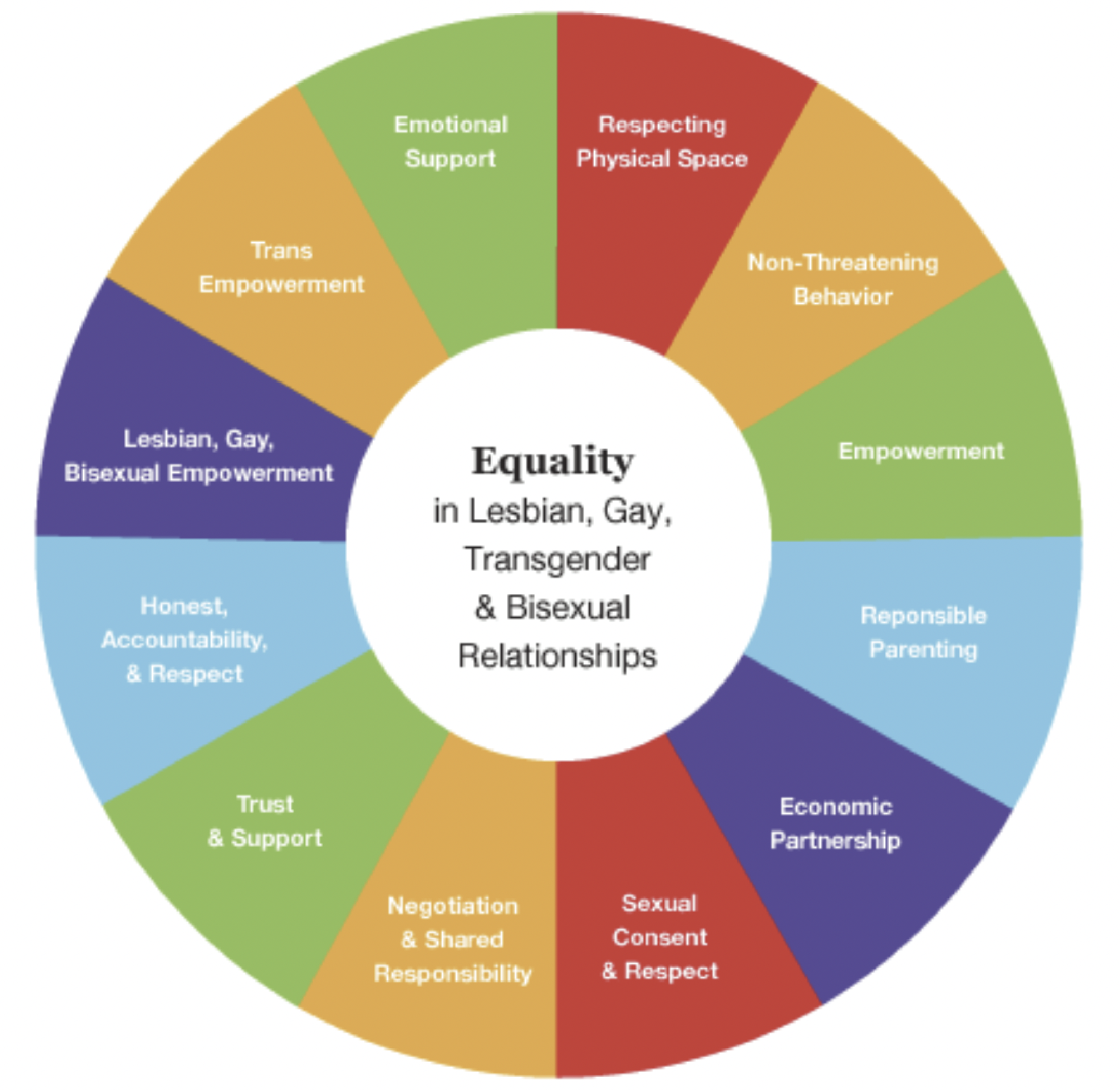
The LGBTQ+ Equality Wheel
One tool for understanding healthy relationships is the Equality Wheel, adapted specifically for LGBTQ+ relationships by Room to be Safe. It describes a relationship where both people:
Share power and make decisions together
Respect each other's identities, boundaries, autonomy, and self-expression
Communicate honestly and listen to each other
Respect each other's limits and boundaries
Support each other financially in fair ways
Feel safe and valued for who they are
This is what you deserve in any relationship.
LGBTA+ Relationships Look Different, and That’s Good
LGBTQ+ relationships might look different from what you might see in mainstream media, and that's okay.
Relationships can be monogamous or polyamorous. They can be between two people of the same gender, different genders, or any combination. Partners may be trans, nonbinary, or gender non-conforming. All of these can be healthy.
Research consistently shows that belonging, affirmation, and connection are among the strongest factors in wellbeing and resilience [1][2]. A community that sees and affirms who you are is one of the most powerful foundations a person can have. LGBTQ+ people also often build deep connections with chosen family. Chosen family are people who show up for us in ways that biological family sometimes can't. Those relationships matter too. All of your important relationships deserve the same care and respect.
The Relationship Continuum
At the healthy end, both people feel safe, respected, and valued. Moving along the continuum, there may be patterns of disrespect, poor communication, or unequal power that don't yet rise to the level of abuse. Further along, abusive relationships involve ongoing patterns of power and control. Two important things to understand about this continuum:
First, frequency and intensity matter. A single moment of unkindness is different from a repeated pattern of control. The further along the continuum, the more frequent and intense those patterns tend to be.
Second, relationships can move along this continuum over time, in either direction. A relationship that starts healthy can become unhealthy. And with real effort, communication, and willingness to change, some unhealthy relationships can move back toward healthy.
This series will walk you through the whole continuum starting here, with what healthy looks like, and building toward recognizing and responding to what isn't.
Relationships don't fall neatly into the categories healthy or unhealthy. They exist on a continuum.

Knowing What You Want and Deserve
It helps to think about what a healthy relationship looks and feels like to you, personally.
What makes you feel safe with another person?
What do you need in order to trust someone?
What are your values: the things that are most important to you?
Your identity, your expression, and your body belong to you. No relationship, romantic or otherwise, should require you to change or give those things up.
You have the right to:
Set limits on what you will and won't accept
Make your own choices about your body and your life
Recognizing when something does not feel safe or right, and knowing you have the right to leave
Reflect
Think about a relationship in your life, romantic or otherwise, where you felt truly respected and valued. What made it feel that way?
[1] Haim-Litevsky D, Komemi R, Lipskaya-Velikovsky L. Sense of Belonging, Meaningful Daily Life Participation, and Well-Being: Integrated Investigation. Int J Environ Res Public Health. 2023 Feb 25;20(5):4121. doi: 10.3390/ijerph20054121. PMID: 36901132; PMCID: PMC10002207. Link: https://pmc.ncbi.nlm.nih.gov/articles/PMC10002207/
[2] Park EY, Oliver TR, Peppard PE, Malecki KC. Sense of community and mental health: a cross-sectional analysis from a household survey in Wisconsin. Fam Med Community Health. 2023 Jun;11(2):e001971. doi: 10.1136/fmch-2022-001971. PMID: 37399294; PMCID: PMC10314672. Link: https://pmc.ncbi.nlm.nih.gov/articles/PMC10314672/