Module 4 · Relationships 101
Module 4: What Is Abuse? The Full Spectrum
In Module 1, we mapped out the relationship continuum, from healthy to unhealthy to abusive. This module focuses on the abusive end of that spectrum: what it actually looks like, why it develops, and why it can be so hard to recognize clearly, especially early on.
Abuse is About Power and Control
Here's the most important thing to understand about abuse: it's not about anger, and it’s not about conflict. It's about power and control.
Abuse is a pattern of behaviors one person uses to maintain power over another. The key word is pattern. One hurtful moment, one heated argument, or one instance of poor communication does not make a relationship abusive. What defines abuse is repetition. Behavior that is ongoing, that tends to escalate over time, and that is always the choice of the person doing it, never the fault of the person experiencing it.
It can look like yelling or hitting, but it can also look like monitoring your phone, making you feel worthless, or threatening to out you to your family. It's not the same as having a bad day or a heated argument. Abuse is ongoing. It's a pattern. It builds. And the further along the continuum it goes, the harder it tends to be to step back from. And it is always the choice of the person doing it, never the fault of the person experiencing it.
Forms of Abuse
One tool for understanding abuse is the Power and Control Wheel, adapted specifically for LGBTQ+ relationships by Room to be Safe. [Link to RTBS website]
It lists the many shapes that abuse can take. Here are the main ones:
Physical abuse - Hitting, pushing, restraining, or physically hurting you. This also includes preventing you from getting medical care.
Emotional and psychological abuse - Put-downs, humiliation, constant criticism, threats, gaslighting (making you question your own reality), and cutting you off from people you care about.
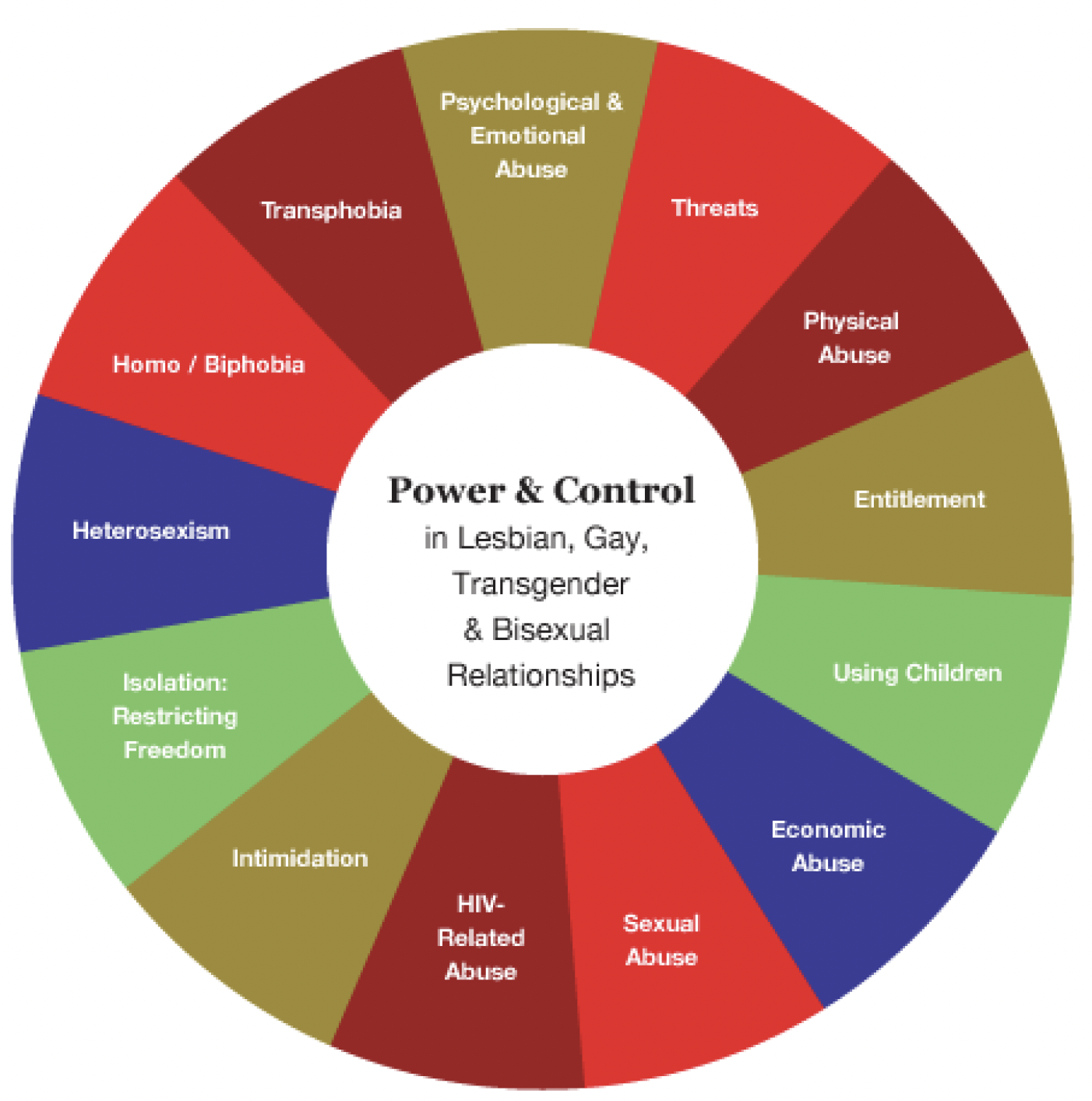
Sexual abuse - Any sexual act done without your consent, including within a relationship. Having a partner does not mean you owe anyone sex, ever.
Financial and economic abuse - Controlling your access to money. Stopping you from working or going to school. Creating debt in your name.
Digital abuse - Monitoring your phone, accounts, or location. Sharing private photos of you without permission. Controlling who you can contact online.
Coercive control - This one is harder to see but can be the most damaging. It's an ongoing pattern of behaviors that include isolation, surveillance, emotional manipulation, and financial control. These behaviors are designed to dominate every part of your life. It doesn't always involve physical violence, but it still causes deep harm.
These types of abuse can be found in any type of relationship. Some of the types of abuse listed on the Power and Control Wheel are specific to LGBTQ+ relationships. We will go over these specific types of abuse in the next module.
Why Abuse Can Be Hard to Recognize
Abusive behavior usually builds slowly. This is part of what makes it so hard to name, especially early on. Early signs, like jealousy or wanting to spend all their time with you, can feel like love at first. The shift from unhealthy to abusive doesn't happen all at once. It happens gradually, one small step at a time, in a way that can make each individual moment seem manageable even as the overall pattern becomes serious.
This is sometimes called the "boiling frog" pattern. Things change so gradually that it's hard to feel the cumulative shift until you step back and look at the whole picture. That's why understanding patterns matters more than identifying individual incidents. Ask yourself not just "did this happen?" but "does this keep happening? Is it getting worse?"
Abusers often have good moments too. That's part of what makes it confusing. It's hard to hold onto what's happening when things feel okay sometimes. The good moments are real, and they are also part of the problem.
For LGBTQ+ people, recognizing abuse can be complicated by real community dynamics. Concerns about being outed, historical distrust of police and shelters, and fear of reinforcing stereotypes about LGBTQ+ relationships are all factors that can cloud how abuse gets named and understood, both by individuals and by communities. That's part of why building this awareness matters. The more clearly we can see these patterns, the less power they have.
Common Myths About LGBTQ+ Relationships and Abuse
There are a lot of false ideas out there. Let's clear some of them up.
Myth: Abuse doesn't happen in same-gender relationships. It does. Abuse is about power and control, not gender combination.
Myth: If you're the same size or gender, it's not really abuse. This is incorrect. Abuse is not about physical strength, it's about one person controlling another.
Myth: LGBTQ+ communities are too tight-knit for abuse to happen. Sadly, no. In fact, close community ties can sometimes be used as a tool of control. A threat to someone's social world can be just as powerful as a physical threat.
Myth: Abuse is always obvious and gets bad quickly. Abuse usually starts small and builds over time. Early signs can be easy to mistake for passion or intense love.
The reality: Research shows that LGBTQ+ people experience intimate partner violence at rates equal to or higher than straight, cisgender people. It happens, it's not rare, and it's not your fault.
Reflect
Before reading this module, how did you define abuse? Has anything shifted in how you think about it?